
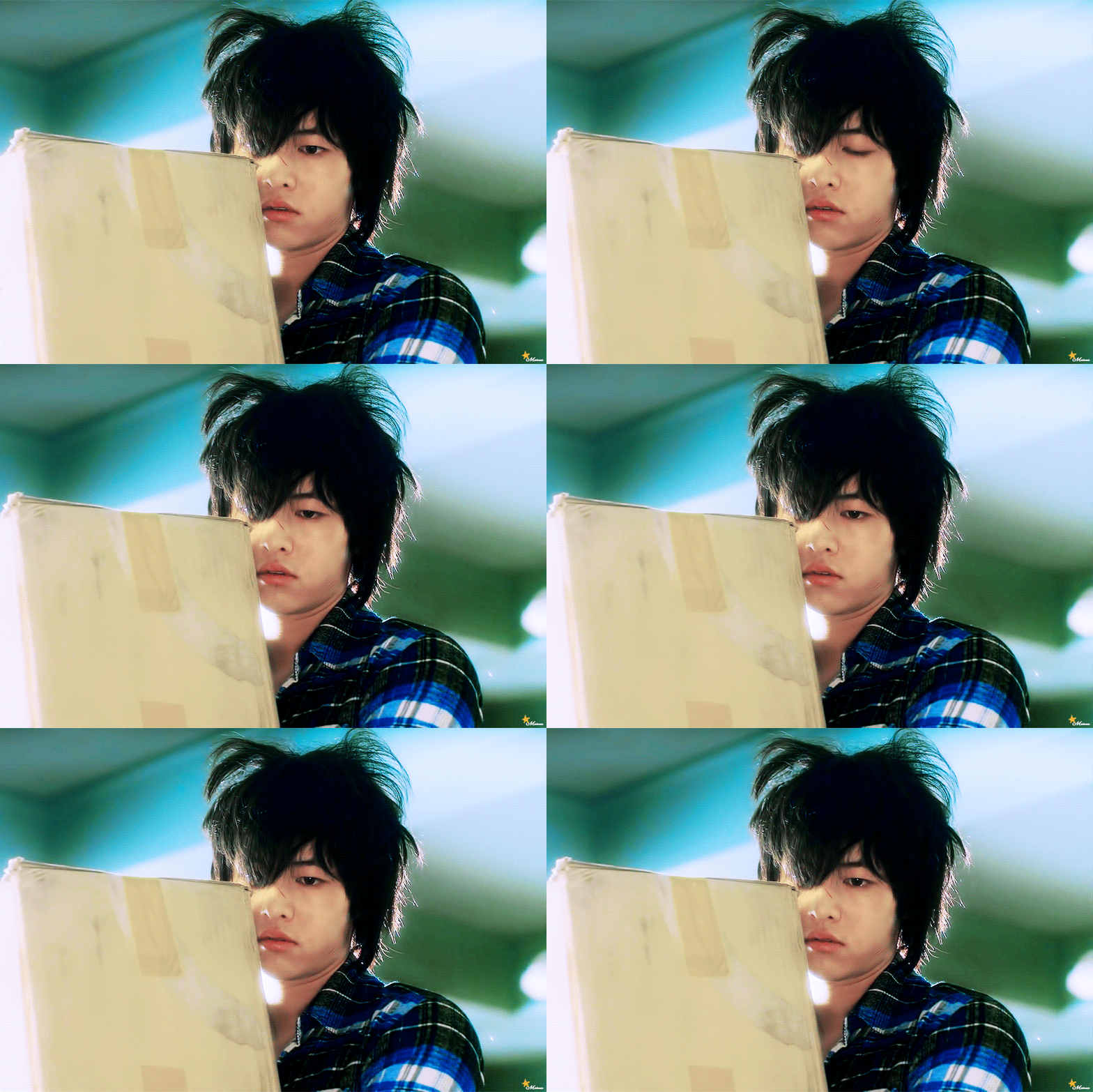
Vincenzo 01 Guwon-gu Nakwon-dong 66-6
w. smallnutt
If you say, "Poverty is a sin," who would dare to stand up and deny it? Everyone might grumble inwardly. But to stand at the forefront, holding a sign, and affirm that poverty is not a sin required immense courage. Few possessed such courage, and that was the cowardice of intellectuals.
When the sun set, it was so pitch black that it was difficult to even guess whether something in front of my nose was a needle or thread without feeling around. Of course, that was the situation inside the house. Outside, it was just as dark, but the situation was better because the lights of the city on the other side, just a long way down, could be seen streaming in, following my outstretched index finger. There were many days when I had to step outside to sleep because of the stuffy air. On those days, I would lie down on a wooden plank that was hardly worthy of being called a pavilion and take in the sky. The stars drifted around the sky, twinkling beautifully, oblivious to their speed. If I felt upset by those stars and turned my head away, the brighter city lights would make me feel sick.
On days when I slept outside like that, natural light would shine brightly in the morning, without even needing an alarm. Neither my long, beautiful eyelashes nor my thick, bulging eyelids could block the dazzling sunlight. As I woke up, frowning, the surroundings were bustling and noisy as always. Very young children ran freely across the dirty, gravel-strewn streets like barefooted Kibongs. More accurately, the term "Kibongs" would have been more appropriate. The soles of their feet were always blackened, as if coated in charcoal, and covered in tiny wounds. Every day was a continuation of the same scene.
That day, my body felt particularly heavy. The twinkling stars, the city stars, were bothersome, and I lay in an awkward position, my back turned to the city, and my neck ached. My back had always been a chronic problem. A peppermint scent, originating from the patch, filled the air of a fifteen-year-old boy.
One day, he was filthy and slow. The patch he'd stuck on was the result of all the sewing, hunched over, all day. He displayed such talent that he dared to say he was the most talented among the village men. While such talent was useless, it was still a consolation rather than being accused of incompetence. He trailed off, complaining about how useless it was, but the praise didn't bother him.
I exhaled through my mouth instead of my nostrils, the pungent smell making me thread through the eye of the needle. My clumsy days were fleeting, but now I was quite used to it, and I wandered around helping elderly people with dim eyes. After grumbling and threading them, I'd tell them, "Try it when you're older. It won't be as easy as you think." But those words just sounded like a curse. Am I supposed to keep hammering nails into this damned hole until my black hair turns white? Damn it. I couldn't even cheer them on, telling them to get out of here and spread their wings. But I could only laugh.
That day, a red-painted motorcycle entered the village. The postman never brought good news, but it was always a long time since we'd seen someone from out of town, so we always welcomed him. Perhaps our neighborhood postman was special, but his face was always familiar. He came infrequently, perhaps to remind us not to forget his face, as he would appear around the time our memories were fading.
You'd think there would be only three or four pieces of mail, but that would be a grave mistake. Instead of a cluster of large houses, the neighborhood was crowded with tiny households, and each had their own bills, including tax bills, electricity, water, and sewer bills. The postman always brought a heap of mail, but he never brought hope.
The mailman strode toward us, his hands full of mail tucked into a red bin on the back of his motorcycle. He cautiously walked around, lest he step on a wrong envelope, before dropping it into the mailbox. All the envelopes were identical. The amounts written on them were generally similar. In this vast neighborhood, not a single house exceeded four figures. It was a kind of reward for the frugality and thriftiness we'd all put in. It was something of a reward.
The townspeople laughed heartily at the postman. Oblivious to the furrowed brows, they kept rambling on about this and that. I hated the sight. As if they were some kind of powerful person, even though they were just salaried workers. As I glared at him with that air, my eyes met with the postman's, who was looking around, clutching the last piece of mail in his hand. I won't deny that I flinched, but I still glared steadily. As if to show off, I was determined to succeed more than him.
For some reason, the mailman wandered around for a while before heading back toward our precariously rickety house. My eyebrows rose slightly. I couldn't quite grasp his intentions. He hesitated, then turned the letter over and stared at the back for a long time. I couldn't quite grasp his unusual routine based on guesswork alone, so I ran to the front of the house. I had already seen him leave the mail in the mailbox.
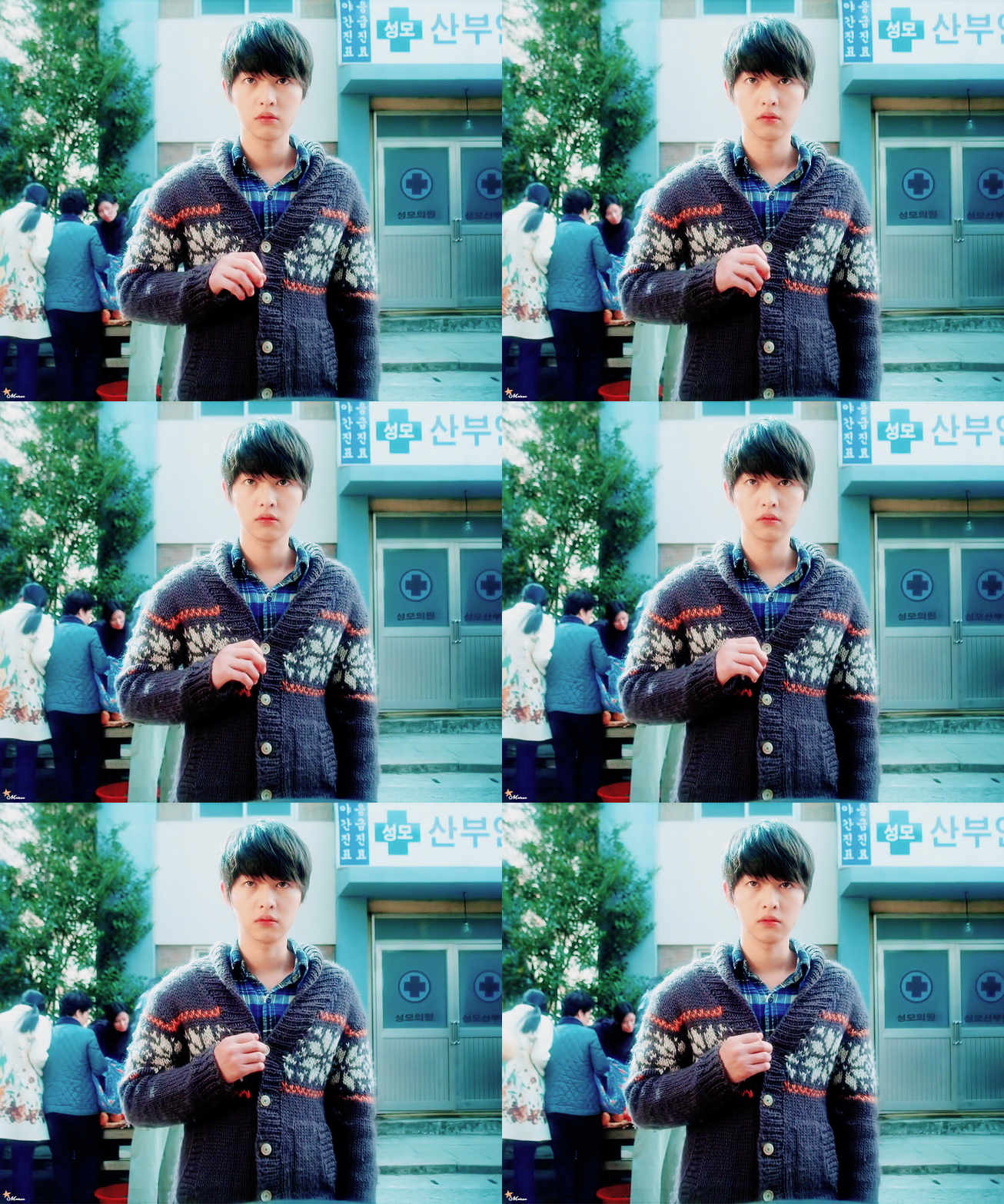
“That… that, sir…….”
After hesitating, I finally spoke. The postman glanced back at my cautious sentence, my shyness so clearly evident. Then he looked back at the back of the letter, his brow furrowed. He repeated this a couple of times, trying to suppress his simmering anger.
“I already received the mail at my house…….”
The postman swallowed his answer to the question and looked me up and down with an unpleasant glare. Was he looking at my appearance? Or my face? And this wasn't even an interview. Only when his thoughts began to spiral out of control did the postman finally find a pause in his mouth.
“You guys are Tae…….”
“Yes, yes. That’s right….”
The moment the postman called her name, she hurriedly answered and hung up. Perhaps it was simply because she didn't want to hear it. In this neighborhood, no one understood her circumstances and called her by her name. It was the ultimate revenge, a resentment against her mother, who, after giving birth, never even spent a night with her, let alone take responsibility for her child, and left to find her own way of life.
The postman handed me a piece of mail. After fiddling with his hands and hesitating, I finally received it. It was a small, luxurious envelope, unlike anything I'd ever seen before, with two names written in elegant handwriting. Even the name "Sender" was a romantic "Guidebook." The "From" field was blank. I guess I realized then that descriptions of letters shining brightly or being dazzling weren't just expressions. It was a truly dazzling radiance. I carefully scanned the envelope, smiled awkwardly, and left before finally opening the envelope. Even his hands were more careful and delicate than ever. Inside was a piece of stationery folded twice.
At that very moment, out of nowhere, a group of children, barely taller than my waist, suddenly gathered and started scurrying around, so I quickly threw them away. This neighborhood was truly a communal life with no privacy whatsoever. I had quite a few complaints, but since nothing really fell under the category of privacy, I didn't have anything to hide. But somehow, I instinctively hid it. And then, abruptly, I pretended not to care.
“What are you talking about? I just checked because the sender was blurry because of the rain. It rained again last night.”
Then, with his index finger, he pointed to the muddy footprints and shallow puddles that had formed here and there. The children looked at him with suspicion for a moment, then nodded, as if finally convinced. It wasn't some lame excuse. He'd already been aware of the villagers' reactions and devised a pretext. After that, with nothing left to satisfy their curiosity, they quickly flocked to other pursuits.
-
The summer heat had arrived a little early, but the fact remained that it was still early spring. The crisp air and the smell of sand had long since been lost behind all the other unpleasant smells, and the season was only felt through the length and shortening of the day. The sun had set quickly. The usual pitch-black darkness descended that day as usual. Perhaps because it had been raining heavily, everything was unusually quiet. I warmed myself in the silence and lit candles. Candles were more romantic than the noisy fluorescent lights.
Only then did I take a deep breath and pull out the mail I had carefully stored deep in the drawer. A pleasant rustling sound of paper lingered in the soft light. I had a feeling that the letter would contain the two letters "hope." Or perhaps something vaguely reminiscent of salvation.
『 I would like to invite you to a special game.
A mafia game that takes place in the Salvation Army.
Prize money will be paid in full in US dollars.
$50,000,000 + a
For further details, please reply to the post office a month later, stating that you will respond to the same sender, and then come to the address below. I'll end here.
The contents of the letter were as above. It was a letter richly filled with sweet, almost tempting words. It was indeed a letter from the romantic Guwon-gu, bearing the two characters "Gwon-gu." Would anyone be foolish enough to tear up a letter like this? The word "plus alpha" in particular struck me.
A normal person would carefully consider the sudden offer of such a large sum, but there was no need to. I felt I would be happier anywhere than here. I was finally leaving this place, where even the curses telling me to go to hell suddenly sounded like words of encouragement. If I just grit my teeth and hold on for just one month…
The address written on the back read:
66-6, Nakwon-dong, Guwon-gu.